Showing posts with label Pinoy Start-Up Founders at Work. Show all posts

4/30/2011

Fanpic with iOS TeachMate App Developer

The best thing about my new work is being surrounded with 'cool' people -- people who design and build stuff. They can already be more than enough subjects for my (make-believe) start-up stories.

So below's a pic with Lord Norlan Mumar, who co-founded ui + code with his programmer wife -- geek couple huh! Being Mac geeks, ui + code will be about fun iPhone / iPod Touch utility applications. 

Their first iOS application released is Teach Mate. It's for teachers. So for those looking what to gift their teachers, you must get them this app. You can find more details about TeachMate at my phmobileapps blog (girls can not have too many shoes, and so is I with blogs).
with Lord Norlan Mumar & TeachMate
Why an iPhone / iPod touch application for teachers? That is probably for another post. But I'm guessing is that because they, Norlan and his wife, had and have been in the academia. 
Teach Mate - Lord Norlan Mumar

3/06/2011

Piclyf: Our Story by Eric Su

I've known Piclyf way back Twidl.it times. A few would ask why I keep on using Piclyf when there are other picture-sharing tools. The thing is I'm not really much into the product, but of the Piclyf team, the people behind the product. It's rare that you can find people here that are courageous enough to go against all odds.

So it was nice to see one of the co-founders, Eric Su, in live talking about Piclyf -- the product, their team, and their story. I'd done a short rough interview of him some time ago, which you can find here.

Most of us only know about start-ups when they're no longer start-ups, which, for me, is just the tip/ending of the story. The real story is when they're still yet to be discovered. So below, you can view the video of Eric Su talking about Piclyf's story, taken during the last meetup, and find out how they were able to survive with only one-week worth of cash for the their start-up team.


I'm sorry for the crappy quality, and I was not able to finish the whole talk since I ran out of batt. You can also find below a (incomplete) video of Eric Su's The Startup Game.


You can check the following links for Eric's slide presentation used during the meetup.
* The Startup Game
* Startup Tips

12/09/2010

Social Network Movie -- Luis Buenaventura (Part 2.5)

To read the previous part of the story, please check Part 1 and Part 2.

With Luis Buenaventura now having a new company brand, Syndeo Media, was he done building social network web apps?

SM Investments

Ohmy, did Luis went back to working boring static corporate websites? It looked not. SM Investment was just probably to pass his time, and that he mentioned that it would probably be his last corporate website.


After changing their company's name -- from PandoraSquared to Syndeo Media, changing brand names became a trend for Luis. Their recently launched (Sept. 2006) social network and music site, MobiusLive.net also underwent a name-lift to Odysseylive.net by Feb. 2007

I'm quoting Luis' comment to explain why MobiusLive.net became Odysseylive.net:

"I should clarify that MobiusLive was a project that we built for Digital Media Exchange, the company that owned Mobius Games, an MMORPG distributor. It wasn't a project that was owned (or for that matter, maintained) by PandoraSquared. 
The software itself was later sold by DME to Odyssey Music, and the whole thing was renamed "OdysseyLive." The website is still operational as I write this, and although I still see hints of the original work when I browse thru its pages, I no longer have visibility into either of the companies that were involved in its creation."


3eep

Luis Buenaventura's factory may have changed names but the social network DNA was quite intact, unwavering. The same time they launched Odysseylive.net, the evil genius and his development team with a population of 2.5 also released 3eep.


Since he had conquered the hackers via highfiber.org, the link-sharing via oks.ph, the gamers via gibbity.com, the film industry via filmcrowd.com, the filthy rich music scene via Mobiuslive.net/Oddysseylive.net, it's time he moved on to sports. Yes, sports! I cannot point out though which part of him is into sports.

The 3eep was a sports-based social networking app for Australia. Yes, Australia.  Pinoys are hooked to malls, not sports, so Luis Buenaventura had to target the Australians for his sports-oriented online community.

Moomai


Just a few months after releasing a sports-oriented social network app, Luis then again started talking about another social network site which he likened to Yahoo! Mash, which was named Moomai. This was the first in-house social network site released by Syndeo Media. But unlike his previous social network sites that were based on his mood and whims and likes, Moomai was where Luis showed his deeper philosophical side.
"But what makes it different, according to Luis, is the rating system based on an old sociological theory called the Looking Glass - that states our sense of self is a composite of what our friends’ opinions of us are, and that we constantly reorient our identity based on the feedback that we receive. 
"Moomai is simply a digitization of this phenomenon, wrapped in candy-colored interfaces and humorous prose."


It was in Moomai where Luis redefined privacy to intimacy.
"The Intimacy idea allows you to define the degrees by which all of these random friends can actually involve themselves in your online life, so you could continue friending everyone you like, but they’d all still just be acquaintances."

And, so a stuff of various artsy fartsy features, following are a few:

Moomai quilt
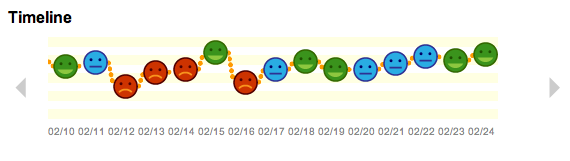
Mood timeline
Mood blaster

Compared to year 2007 and previous years, year 2006 was a lean period for Luis' social network factory with only MobiusLive.net as being produced (this is just based from the accounts on his blog). It can be that, Luis was adjusting with his new team and 'office' environment in 2006. But year 2007, he picked up again. I guess he with the Syndeo Media was able to adjust and had learned how to blend well and get the most out of each other.

So what year 2008 was like for Luis factory? Yes, this story is not yet done. I have already run out of words to storytell Luis social network footprints, but there are still more. And, I secretly pray that no more new from him before I'm done with this Luis Buenaventura's Chronicle of Networknia.

So before you go enjoy your Christmas and Holiday vacation, remember that Luis made some of his social network apps by skipping holidays.

Social Network Tetris (for those asking)
In the next part, final part, based on the previous parts, the trend is that Luis Buenaventura is still making social network apps. But we'll try to see a little bit of him being a social specie.


(Note: This is Part 2.5 because I no longer want have a Part 4. Let's leave the part 4 and 5 and to infinity and beyond to Mother Lily's Shake, Rattle, and Roll.)

12/07/2010

Niel Dagondon's Anino Games -- Philippine-based Game Makers

PH game maker lives out boyhood fantasy


By Cecil Morella
Agence France-Presse
First Posted 11:54:00 12/06/2010


MANILA, Philippines - Inside a brightly painted red and green building in the Philippines' financial hub work is more like play for a young team making funky electronic games.

Niel Dagondon may be the boss, but the 30-year-old is living out his boyhood dream running a company that creates games for iPods and iPads, smartphones and websites such as Facebook, as well as game consoles and personal computers.

"I've always wanted to make computer games for a living," Dagondon told AFP in his office that looks more like a children's play centre.

Yet in his playpen, Anino Games, designs and tests game concepts using some of the most expensive three-dimensional graphics software in the business and is packed with brilliant young minds.

Anino, the Filipino word for "shadow", has been crafting games since 2003 for many of the world's biggest entertainment firms such as Walt Disney, Namco, Atari, and Electronic Arts.

The company is growing up fast and has 45 developers with an average age of only 25 -- a team weaned on all-night computer combat games such as "Counterstrike", "Warcraft" and "Ragnarok".


Anino's roots can be traced back to 2001, when Dagondon was a 21-year-old college student trying to turn a game project from his computer science studies into a commercial product.

Dagondon eventually burned through about P5 million ($115,000) of his own money over the next 2 years as he and 7 developers brought the first-ever Philippine-made commercial game to hit the market.

He said the product, a role-playing game set in 16th century Philippines when Spanish colonisers first arrived, was not a major success but it crucially gave his small team experience and contacts to sell internationally.

11/03/2010

Social Network Movie -- Luis Buenaventura (Part 2)

To read the previous part of the story, please check Part 1.


If in Part 1, Luis Buenaventura was weaving webs of social sites left and right hacked during holidays when everyone is getting cozy. At this part, we could see Luis got entangled more in the webs of building start-up companies than producing social networks. So you might see more company names than product names in this post. Just like the Part 1, all things written here are from my imagination and interpretation so please do not take them as facts.

PandoraSquared

With Luis' factory of social sites, he got the attention of a Web 2.0 company PandoraSquared -- think 37signals. Probably after a lot of wooing, PandoraSquared was able to convince Luis to be part of their team. Luis then became part of a Philippine revolution -- Web 2.0 revolution here in the Philippines which was PandoraSquared's goal.

Though, I could say that, with his social network factory, Luis already started one without consciously knowing it. Maybe Luis should get the Father of the Philippine's Web 2.0 revolution.

MobiousLive.net

Just like it's name, it's hard to guess what MobiusLive.net was. This product started as one big secret, and mixed with dramas down the road.

Unlike with his previous projects where Luis usually openly shared in his blog what he'd been working on even before the release, he did not share much information in his blog. This was a signal that MobiusLive.net was something really big to happen in the Philippine history. He was mostly secretive about this one except for a few bits of hints here and there.

But even before he was officially part of Pandora Squared, he already dropped a hint in his April 2006 post that the next industry he would conquer is music after highfiber (web programming), oKs.ph (digg-ish), gibbity (gaming), filmcrowd (movies).

Then, a month before they opened it to public, Luis posted another hint,
Work on our next major project has been slowly unwinding; I’m not sure exactly how much of it I can write about without breaking our pinky-swear NDAs so I’ll just say that we’re putting together a very big Filipino social network focusing on one of my favorite things (no, not poker).

It was by Semptember 2006 when they had finally shared it to public their top secret project -- a local / 3rd world equivalent of iTunes, MobiusLive.net. Leaping from Kevin Rose to Steve Jobs, Luis Buenaventura made it look like it's an easy task.

As described by him, "MobiusLive.net is a social network focused on local independent music."

MobiusLive.net offered Php 20 per music track. And as Luis style, he could always start big even at the start. They were already able to feature popular local bands -- Greyhoundz, Chicosci, Valley of Chrome, Queso, and Narda.

Syndeo Media

Just like in the movies, some drama had to happen. Just right after they made the first Filipino iTunes / social network for music made publicly available, they called it quits for their PandoraSquared company. But it looked like more of renaming their factory name to Syndeo Media, than quitting. With new name came new strategy:
syndeo::media exists to build its own, internally-spun web
products, but we’ve come to the conclusion that our current resources
will not be sufficient to properly support all our ideas. The strategy
now becomes fairly obvious: over the next few months, we continue
looking for client work and refining our process. Once the appropriate
resources present themselves, we can apply all our learnings to our own
brands.

And, a hint that they would welcome 3rd-party investment. With their reputation, it would not be hard. So was it money matters?

Lesson learned: With revolution comes drama (sweat, bloods, and tears?).

Watch out for the next part. Would he be back to building corporate websites, or be chased by investors?

Part 2.5 is now available here.

10/25/2010

Social Network Movie -- Luis Buenaventura (Part 1)

While everybody is getting zombie chitchatting about their life and others lives on social sites; Luis Buenaventura has been busy building not only a social network site, but a factory to spin webs for his many social sites, which are to make the world a better place, or to simply satisfy his needs, or whims.

Behind those dark glasses are social sites hiding
(Image from guttervomit.org)
I read the whole of his blog, guttervomit.com, as part of my 'research' about him. And, I'm just simply amazed at the different social networking sites he's spitting left and right that I cannot help but post a blog about it. I can imagine that right at this moment, his mind, even asleep, is probably busy weaving ideas after ideas for his next web toy.

Following is a list of Luis Buenaventura's web products, which I harvested from his blog. So this might not be a complete compilation. These are just based on my interpretation, so do not take them all as facts. Let's just call this a fan's tribute.

Highfiber.org -- In 2001, before graduating from UP, Luis put up highfiber.org, which is a, lifted from their facebook page:
"... community website started by Luis Buenaventura as a way to learn web programming back in 2001. It became fairly popular amongst web-geeks, goth-chicks, attention-whores, and people looking for pr0n and wareZ for quite some time." 

So, as you see, Luis created highfiber.org to answer a need, which was to learn programming, which, of course, then created a web community and has help others too.

B&B Multimedia -- This is not a social site, but a company Luis Buenaventura created in 2005. He sold his iRiver H320 for Php10,000 to fund his B&B. Their team were mostly into setting up websites. But even being a newbie at that time, they were already able to bag big-named clients; just to name a few, they got Philippine Ad Congress, Ayala Land International, myHomeland, Red Ribbon, had a deal with a UK-based marketing firm, and others.And, to top it off, some of the websites they created were web award recipients.

So it looks like his iRiver was a lucky charm.

oKs.ph -- In between working for his B&B clients, Luis was still able to pull off his oKs.ph November, 2005. Probably to keep his self from getting bored creating stiff corporate websites where he could not implement his bleeding-edge technologies.

The oKs.ph was an experiment to test if Filipinos were ready for a user-generated web platform, which was quite popular at that time, ala Digg. Or, maybe it was also an experiment to create a Kevin Rose of the Philippines.

After oKs.ph, Luis created a mini-flood of Web 2.0 social collaborative sites. Year 2006 was probably the year that he moved from building boring corporate websites to social network sites. His frustration over Red Ribbon's disapproval of his drag-and-drop shopping cart feature had probably driven Luis to create his own web projects which he can shape according to his fancies and whims.

gibbity.com -- It was a people-powered game review site. Just 2 months after his oKs.ph, while people in this side of the world were enjoying the New Year celebration, Luis was hacking the night away for his next Web 2.0 collaborative site. He released it after 10 days to the public to get help in weeding out bugs. It then became the first Web 2.0 application developed in the Philippines, got featured in Lifehacker, and the rest is history.

filmcrowd.com -- As its name suggested, it's the equivalent of gibbity for film reviews. It was created the same year gibbity was created. But while gibbity was a New Year baby, filmcrowd was a Holy Week baby. (Lesson learned: And, you wonder why Luis has fame and fortune? It's simple -- skip holidays.)

Were these two review sites created as yet to satisfy another set of Luis' needs? Well, he seems to love games and movies based on his blogs. But he confessed in one of his blog posts that he got the idea of collaborative review sites from the CNET's Buzz Out Loud podcast where one of the hosts, Molly, mentioned:
"She said something to the effect of "the only honest review is the user review," which set off a light bulb in my head the instant I heard it."
That Molly's statement had not only set off a light bulb, but plenty of light bulbs in Luis' head that he was determined to be a social site breeder. From his post:
"Eventually, I hope to have a family of user-review sites that each focus on a different medium, ..."
(Lesson learned here is that it pays to listen to podcasts.) 

What's next?
(Luis Image from guttervomit.org)
Please watch out for the next part. Web geeks, web links, game reviews, movie reviews -- what were Luis next web toy / social site / whim?

Part 2 is now available here.

9/28/2010

JJ Lumagbas -- Turning a financial glitch into an application

JJ Lumagbas
Founder/Developer, txtexpense (Alpha)


In one of our conversations, JJ once told me he wants to build his own version of Mint.com. And, he's not faraway from it, his can be even minter than mint. He is also currently a ComSci professor at University of the Philippines Cebu.

1. Of all the ideas you have in mind, why create an application that is about expenses? Was it a random decision?

You know that feeling you get when your paycheck runs out and you say, "Now where did all my money go?" Multiply that by 4 years and you know how I felt after I quit my programming job last year. Since then I've always tried to keep track of my expenses. I started by listing them in a notebook at the end of every day, then switched to my phone, since I had it with me wherever. After 2 months, I wanted a big-picture, so I encoded my expenses into Access. It was such a pain-in-the-ass to encode that I started thinking of an easier way.

2. How long did it take you to build the app from scratch to alpha?

I spent a month learning ruby (leisurely ;)), 2 weeks to get the basic structure of the app down, and another 2 weeks to get the SMS part working.

3. How do you manage creating/maintaining the app at the same time teaching at the university?

I got to be a faculty intern at CodrSchool, so I had a summer break to build it. Since real school started I'm down to once a week for a few hours for maintenance and new features. Embrace constraints, right? (Ed: Embrace Constraints by 37signals)

4. Please tell me about how you design its web interface, and what’s underneath it?

Plain-vanilla HTML. Repeating "keep it simple" kept me from adding ajax and other fancy javascript. For now, at least.

5. Why are you doing this?

To become this guy -- Markus Frind of Plentyoffish.com

6. Upcoming plans and features we can look forward to in txtexpenseWhat feature you are currently working on?

Budgets 

Top features/developments that are priority on your list now.

Better analysis of expenses
Email/SMS Notifications

9/21/2010

Eric Clark Su -- Philippine's Mark Zuckerberg


Eric Clark Su
Co-Founder/CEO, Twidl Inc.
Generalist, PicLyf (Product of Twidl Inc.)


1. Who are you and what’s the elevator pitch?

I am Eric Clark Su, co-founder of PicLyf - communicating around pictures.


 2. I remember it was Twidl.it before. Why did you change it to PicLyf?

The idea evolved enough that it didn’t fit the name at all anymore. Twidl it came from Twitter + Doodle but we were excited to build something that can let people communicate visually in an open-ended way so we needed a new name to fit that idea.

3. Before PicLyf, were you already doing other start-up ventures or involved in other start-up projects? If yes, what were they?

Not really a startup per se, but I started an indie game development shop with one of my PicLyf co-founder - Blue Jayson Basañes. I wasn’t really aware of this whole startup movement / philiosophy until a few months after deciding to do Twidl it (which became PicLyf) with both BJ and Andrew

What made you decide to go the start-up way?

I think it came from wanting to solve the problem of having no good place to communicate visually. I had an idea on how to solve that and got partners to sign on board to help me realize it.

4. Back to Piclyf, of all the ideas you can create a web application, why create about pictures? 

Pictures have very great characteristics in them that I thought made them a very good form of communication compared to text, audio or video. They are less boring to look at, easier to make interesting, more freeform, universal and very portable. There were a lot of application that lets you share photos but each site had philosophies that were less freeform and as a consequence made it very weird or out-of-place to show off something that didn’t conform to the community.

Who came up with the idea?

It was initially my idea though it evolved greatly as I bounced it off of my co-founders and what the early users were doing. 

5. What are the high/fun moments of Piclyf as a start-up?

There were no high moments during PicLyf, it was pretty much depressing stuff after depressing stuff. Just kidding. The highs came mostly from solving problems and watching what our users do on the site.

Any moments/events that make you think of backing out from Piclyf, or from ‘start-up life’ in general?

Gosh, I never thought about quitting it but I always thought about moving the company somewhere else besides the Philippines. I wish this wasn’t true but Philippines is probably one of the most weirdest place to be a startup. The friction is huge with everything and a lot of the people you think who can help you, won’t. But I am glad we are starting to grow a community on the site, i do think it will get easier as we go along.

6. What were the biggest mistake you have done so far?

It would probably be not focusing enough on the mobile clients, we probably took a bit too much time on discovering our user experience but i still it was necessary.

7. What was the most surprising thing you have encountered while building PicLyf?

How hard it was to find the right people. We have cycled thru a total of around 40 applications, interviewed and tried 10 to 13 people and retained only 2. We still lack a couple of key hires but we believe that its better to be understaffed than being wrongly staffed.

8. You have the generalist title in the Picly’s About Us page, what are the different roles you have in Piclyf

I’m responsible for the vision of the startup (which changes every week or so.), the visual design, the user experience and a few other aspects of the company. BJ does all the hairy technical stuff and architecturing, Andrew handles the operation, finance and the ‘etc’s. Mark does all the magical jquery UI stuff + some modules and Sherwin is in charge of the game mechanic modules as well as a couple other ones.

Which role you like most/most passionate about?

I think it would be where I am shaping the product and designing it.

Which role you least like, if there is any?

Dealing with paperworks, and other non-product tasks.

9. Last, what music puts you in the zone to ‘work’?

Lately, its been a dose of Interpol, Radiohead, the National and new stuff from thesixtyone.com or wearehunted.com.

-----------------------------------------------

The slides from his y4it event talk.


9/06/2010

Milo Felipe -- Thoughts from the Man Who Started a One-Man Software Company

Milo Felipe
Founder/Developer, milObjects Software


1. Based on your blog, The Art of the Start of Guy Kawasaki inspired you to start a company back in 2006, so what was the first thing you do when you start your company? Did you quit your job? Or, you started milObjects as a side project while you maintained a corporate job?

The first thing I did was file my resignation. Then during the 30 day notice period, I went through the process of registering my company. My last day was Oct 20, 2006. I didn’t have any idea what product to do when I started milObjects. I really just wanted to not be an employee. I was freelancing while I maintained a corporate job. I thought,”why not make freelancing my main job?” My goal then was to just earn the same income as my corporate job’s income. I was hoping of getting more consulting projects if I had a registered company, even if it’s a one-man sole proprietorship business.  

What was your family/friends reactions to your decision?

They we’re all supportive.

--------------------------------

2. SignAppNow (milObject's online sign-up sheet product) was launched in 2009, so what projects were you involved between 2006 and SignAppNow then also your Android applications?

I’ve been doing consulting work since I started and up to now. It is still my main (and only) source of income. SignApp Now and my android apps aren’t generating substantial revenues (yet). I do consulting to bootstrap development of SignApp Now and other product development efforts.

-------------------------------------

3. About SignAppNow, of all possible applications you can develop, why online sign up sheets?

I was consulting for a company and I was given a company email address. I noticed HR sending emails to everyone asking them to sign up to something by replying to the email. Everyone was hitting “Reply to all” so everyone was receiving all the messages. The email thread became so long as people were appending there names to the thread. I got the idea for SignApp Now from this. I thought, “What if there was a simple way to get the names of people who’d like to sign up for something?” It had to be very simple. I got the idea for the no registration required from Posterous.com. I didn’t even bother to look at there were already existing sign up sheet apps until after I released (there were some existing sign up sheet apps already). I was also learning the Grails framework that time so I was quite determined to build the app. I release a very basic version and got some positive feedback. The current app is quite simple and people are requesting for some advanced features. So watch out for version 2. =)

SignApp Now won’t definitely be the last app from milObjects. =)

4. SignAppNow has a pretty web app interface, it looks neat, eye-candy but not cluttered. (Sorry for my non-techy terms.) Are you the only one behind the interface design?

I came up with the design idea and asked a friend, Irving DelaCruz, to implement it. He’s my partner for SignApp Now.

Are there other web apps you get inspiration from when you do your design?

I get inspiration from the apps of 37signals and all the other “simple” apps out there.

Do you have someone you look up to in terms of designing?

No specific person. I just try to learn from the design of all the other apps out there.

Any books you read and can recommend when it comes to designing web interfaces?


Any secret weapon/tool you use for designing?

None

-----------------------------------

4. How many are you in your team? What are the different roles you have to play?

milObjects is just me. I’m a one man company. For SignApp Now, it’s just me and Irving. Irving does everything involving graphics and images. I do everything else. I gave him 3% of SignApp Now.

-------------------------------

For more screenshots
of milObject's 3 Android
Apps, click here.
6. Just based on your SignAppNow, my impression is that you are an Apple fan (they’re usually so obsessed with interface design), so I’m wondering why you created android apps? Why not apps for iPhone?

I like Apple products, but I’m not a fan. I don’t buy every new Apple product that comes out. I don’t stay up late to watch Apple announcements. I had a MacBook before that lasted me for 3 years. I’m saving up for a new MacBook Pro, but I’m not in a hurry to get one. I can still work with my Asus laptop. I have a first gen iPod touch that I still use up to now (just for watching videos). I created android apps because I already know Java (android uses Java). iPhone uses Objective C and I just don’t have the time (or don’t want) to learn Objective C.


-------------------------------

7. As a start-up guy, what are the funny moments? Moments that inspire you to continue doing what you are doing?

I can’t think of any funny moments. I get inspired by other startup’s success stories that I read or get to know of.

Are there moments that you also feel giving it up? 

Yes, always. For example, when I think of an idea and try to do it and realize how big the scope is or how difficult it will be for a one-man team to pull off. Sometimes I think of just returning to being an employee or migrate to another country.

---------------------------------------

8. What is your dream application to build?

I don’t have anything specific. My dream is to build something that will give me enough income to stop doing consulting work. =) It doesn’t have to be a multi-million dollar app. Just something small and easy for a 1-5 person team to maintain.


8/19/2010

txtexpense (Alpha) - track expenses through SMS

I'm a klutz in budgeting. Well, I'm not really a big fun of budgeting -- I don't want any heart attack please.

But I give txtexpense a try because the person who created it is a friend. And, I'm kind of amazed how he did it singlehandedly while he is a University faculty at the same time, of course with his beautiful girlfriend on the side. =)

After some time, I get the hang of using it. One is it's easy because it's just a text away. So instant and eeny weeny purchases are always tracked. But what I most love about it is that I don't need to see a spreadsheet of my expenses just to list down my expenses. A programmer friend once shared to me his created excel file for tracking expenses but I stopped using it because every time I put down my expenses, all the figures are splashed across my face. It's scary when you see you're already way out of your budget.

With txtexpense, I just keep texting to the application my expenses, then just view them at the end of month or when I am ready to face my bankruptcy.

For those budget OC, this will be a bestfriend to keep. =) Simply sign up for it via web, then keep the gateway number in your phonebook so you can easily text your expenses into your account.

JJ Lumagbas keeps making an emphasis that the application is still in alpha stage so you might experience some bumps and rough patches. But it also means, a lot of features are also coming up. In one of our random conversations, he talked about:
* being able to set a budget, then you will get a text if you are nearing your budget limit -- This I'm really looking forward to.
* being able to inquire about your expense status to help you decide before making a purchase
* making saving/budgeting a social experience -- you can enlist friends/family that can get reminder if you are about to get bankrupt, this way they can nudge you to fix your spending habit. Or, they can praise/like/poke if you are doing well in managing your expenses.
* and others.


For now, you can text or input your expenses via the web.

As the home page says, you can find out where your money goes.
Then, monitor your spending changes. Isn't it cute? It's like our VECO bill.

I'm hoping to catch up with JJ soon, and hear more stories from him about his 'creation.' Pictures below from his Crazy Friday presentation, this was way before its Alpha Launch.


Please do check out TXTPENSE at http://txtpense.codrschool.com. And, also like its facebook page here.